

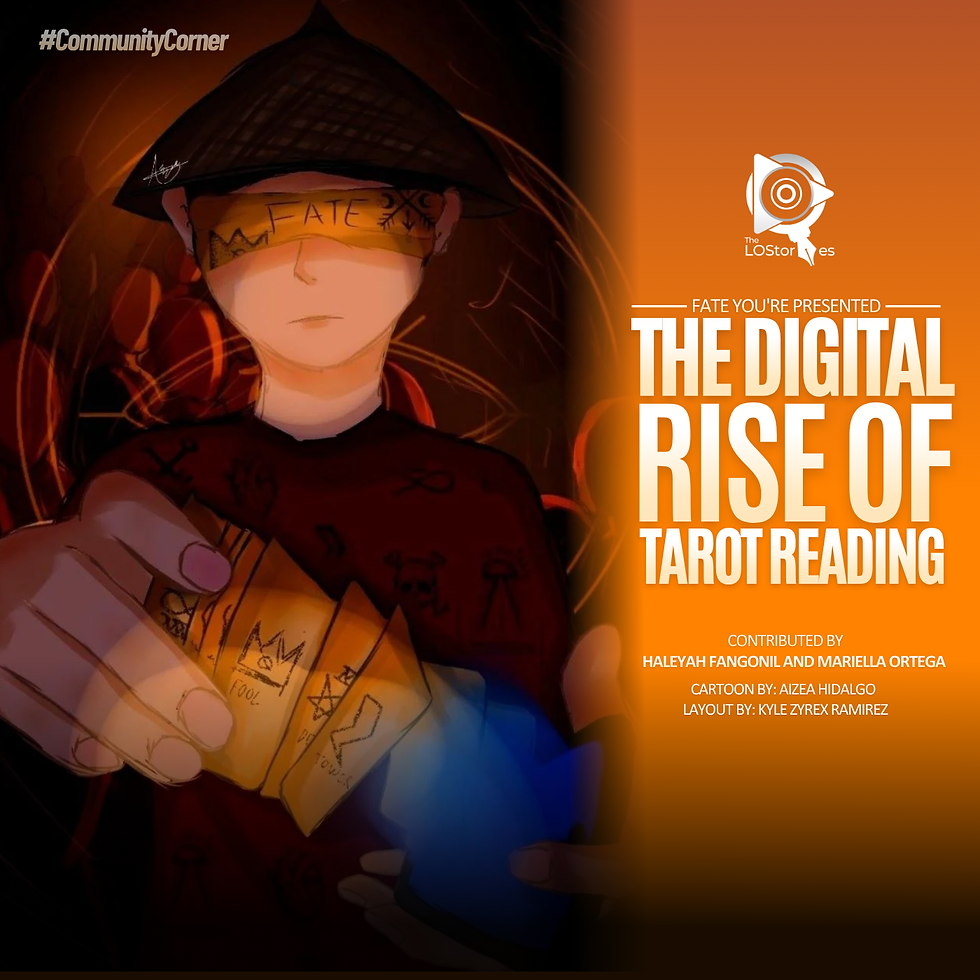
Fate You're Presented (FYP) With: The Digital Rise of Tarot Reading

What if the life you’re living has already been written?
‘Fate’ has always been a tempting idea. The belief that some paths are already written long before we choose them. It resides in the questions people ask themselves: ‘Is this really meant for me?’ ‘Are we gonna end up together?’ or ‘Am I heading in the right direction?’
For some, the answers are found in logic or experience. For others, they are drawn from something more intuitive, laid out not in certainty but in symbols.
Tarot reading, built on a deck of 78 cards, offers guidance through this practice. A tarot reader shuffles, a seeker chooses, and meanings are drawn not only from the cards themselves but from the energy and intention behind each question.
Now, this once intimate, face-to-face practice has moved online. With a scroll, anyone finds readings with the familiar disclaimer, ‘take what resonates, leave what doesn’t.’
As it continues to flood digital platforms, one question lingers: Does ‘fate’ truly exist, or are we just trying to make sense of it online?
The Philippine Lore
In a predominantly Catholic country like the Philippines, it is no surprise that tarot card reading is popular. Long before the Spaniards introduced Christianity in the country, our ancestors believed in anitos (ancestor spirits, nature spirits, and deities) and Babaylans (spiritual leaders) who practiced divination.
And even when the religion forbids the use of tarot cards, one cannot enter the Quiapo Church without passing through the tables of fortune tellers. One of the most common fortune-telling methods is tarot card reading.
Whether sought as a guide or for fun, people rely on tarot reading for future prediction, self-understanding, and clarity for aspects like relationships and careers, especially during uncertain times.
Maybe the growing demand for tarot reading is what draws more people into the practice. Or perhaps, it works the other way around, where more readers create more demand. Or maybe tarot has endured for centuries because it continues to adapt over time.
For Jaycel Villasica, also known as astrolojayce on Instagram and TikTok, her interest in tarot cards blossomed in 2022 when it took over her Twitter (now X) feed. That same year, she bought her first-ever deck of cards and tried reading for herself and her friends.
“I’m surprised because they say it’s accurate. Then, I read for myself too, and I find that it’s really accurate,” she tells us in an online interview.
After mastering tarot card guidebooks online and seeking validation, Jaycel started making digital content and offering services online.
Like other tarot card content creators, her comment section is flooded with “Claiming”, “Manifesting”, etc., to affirm the positive message, followed by clover and prayer emojis.
One of these followers is Richmond Apocero, 18, who claimed the positive energy in a tarot card in hopes of passing the 2026 University of the Philippines College Admission Test (UPCAT).
Growing up in a Catholic family who sees tarot card reading as a sin, Richmond did not embrace the practice at first. But as time went by and as more tarot cards visited his TikTok’s For You Page (FYP), the love and career readings started resonating with his situation.
“It’s weird because every time it would appear in my For You Page, it always resonates with what’s happening in my life,” he narrates in an online interview.
The same sentiment was shared by Jedi Doma, 19, who initially ignored the long tarot card readings that would appear on her FYP. At first, they felt too drawn out, easy to scroll past, and dismissed as just another video. But that changed when she found herself liking someone.
After multiple “Bestie, this is your chance” appearances in her FYP, she became intrigued and had a monologue, “‘That video is similar to my situation right now’...Then there, I became invested,” she tells us in a personal interview.
Similarly, Nina Henson, 19, only believed in tarot when she started dating, five years after tarot content found its way to her TikTok’s algorithm.
After scrolling through multiple “Oh, they'll text you back” or “Oh, there are signs,” she became reliant on the universe's signs and now views tarot card practice similarly to a religion.
“It gives me something to hope or hold onto…I guess it guides me in this confusing time of my life,” she says in a personal interview.
Take What Resonates, Leave What Doesn’t
With the rise of online tarot, the practice has taken on different forms. Once confined to face-to-face readings in Quiapo, tarot now appears on digital platforms through “collective readings.” These are often seen on a user’s For You Page, featuring specific zodiac signs or general symbols such as angel numbers, alongside messages like, “If you see this reading on April 25 to April 27, then this reading may be for you. Take what resonates, leave what doesn’t.”
This type of reading is meant for a wide audience, allowing a single message to reach thousands of users at once—blurring the line between personalized guidance and mass content shaped by platform algorithms. What was once intimate and one-on-one is now something that can appear in between scrolling sessions, turning spiritual guidance into shareable, repeatable content.
Meanwhile, seekers may also book online readings, which are more personal. These sessions are conducted through platforms such as Google Meet or Zoom, reflecting how even spiritual services have adapted to the same digital spaces used for work, school, and social interaction. In this setup, the tarot reader selects the cards based on the client’s energy and question. Some readers also interpret the cards independently and send the reading in PDF format via email, making the experience both flexible and accessible.
“It was about love,” says Richmond. “I was in Grade 11 at that time, and I’m very desperate that I asked my friends if it’s worth it to go to Quiapo to do a love reading,” he adds, laughing.
To believe in tarot is to hold on to the hope of guidance while still recognizing its uncertainty, placing it somewhere between faith, entertainment, and emotional coping.
“I already accepted that when I go to a tarot reading, I have this mindset that there’s a possibility that what they’re going to say might not be true,” Jedi says. “The P150 that I paid for will go to nothing.”
In a time where decisions about relationships, careers, and identity feel increasingly difficult to navigate alone, it is often this lack of clarity that will push people to seek guidance.
“If they don’t find their answers within themselves, that’s where they seek tarot reading,” Jaycel says. “It’s something that’s outside force, it’s outside yourself [the answer].”
Finding Meanings and Purpose
A study published in the Asian Journal of Psychiatry found that the COVID-19 pandemic intensified anxiety and uncertainty among Filipinos, while also reshaping how they seek support. As traditional systems became less accessible due to stigma, cost, or availability, many turned to alternative forms of guidance, including tarot, which offers quick, accessible, and judgment-free responses.
Still, some believe that tarot readings can reflect real-life outcomes—experiences that often reinforce belief, especially when vague messages are later connected to personal events.
“There are still readings that became true,” Jedi says. “Some points are like… hit the head, like I said ‘Ay, oo nga, nangyari nga ‘yan.’”
Meanwhile, Richmond, in seeking tarot online, also experienced something that happened exactly as the tarot reader said.
“It was during my 10th grade. During that time, I applied for a science high school, so I took a test,” he shares. “Then, after one week, the video of Blessedbhie appeared, saying there would be a redirection in my life that is very big that might affect my career. Then, I didn’t pass the science high school test, but I was accepted as a scholar student in a private Catholic school.”
While tarot may serve as guidance, some seekers misinterpret it as something that can predict the future, turning it from a reflective tool into a perceived authority over real-life decisions. For others, it becomes a way to validate desires, cope with hesitation, or search for reassurance in difficult situations.
“There was this girl who sought tarot because she had legal trouble… She was being sued by a company because she mishandled the funds of the company,” Jaycel shares. “I was shocked because that was her problem. I am not equipped to handle that.”
Questions in tarot readings have also become more specific over time, making it a tool for seeking answers in highly personal and complex situations.
“There’s this one client… she’s from another country,” Jaycel says. “She was a mistress then, and she was asking if the guy would leave his family just for her.”
As tarot continues to expand online, its reach and influence also grow. Platforms like TikTok and Facebook make readings more accessible, allowing tarot to reach younger audiences and integrate seamlessly into everyday scrolling habits. However, this accessibility also makes readings more prone to misinterpretation.
“Tarot only shows possibilities, patterns, and current energy; it’s not a fixed destiny,” Jaycel reminds those who seek readings.
For many, tarot provides a sense of reassurance, offering immediate answers in contrast to the slower, often more difficult process of self-reflection.
“There are many tarot videos that will tell you, ‘Bestie, this is your sign, claim it now.’ Eh, there are many desperate and hopelessly in love that wanted to affirm,” Jedi says.
Hope, In All Of Its Possibilities
With this growing influence comes responsibility for tarot readers, whose words can shape how clients interpret their situations and, in some cases, influence real-life decisions.
“It’s your responsibility as a tarot reader to reassure your clients and everyone that they have the free will to change their circumstances,” Jaycel reminds. “I hope that they will avoid saying that ‘Oh, this is your absolute fate, you can’t do anything about it.’ I hope they avoid fear-mongering as a tarot reader,” she adds.
Tarot reading remains deeply embedded in our culture, existing alongside religious beliefs and traditional practices in the Philippines. In places like Quiapo, it continues to be associated with long-standing spiritual traditions. The desire to seek answers, whether about career or love, will always remain part of human nature.
“You know more than you think,” Jaycel says.
As tarot evolves in the digital age, its presence shows no signs of fading.
“It will eventually flourish in the future. One might actually try to predict who may win in the 2028 elections. It’s a long-term practice, not a fad,” Jaycel adds.
For Nina, tarot is becoming more integrated into everyday life.
“There’s also a tarot card reading at a house party eh,” she says. “It’s gonna be a normal occurrence like in the gigs, activities, and things.”
One may hope for the life they’ve always wanted. And in doing so, look for something to hold on to.
“Destiny is not fixed and set in stone. It will still play out in your lives,” Jaycel reminds.
As time passes, the human quest for answers continues to evolve—from face-to-face encounters to algorithm-driven readings that appear with a swipe.
Fate, for some, may be real. But as people immerse themselves in digital platforms, it takes on different forms. In subtle interactions, meaningful actions, or even in cards. In times when the future feels uncertain, tarot offers something many continue to seek: a sense of direction, reassurance in moments of doubt, and the comfort of feeling that their questions, no matter how hard, are being heard.
And maybe, for people like them, hope isn’t dead after all.
“I passed the UPCAT 2026 po,” Richmond shares.
NOTE FROM THE EDITORS:
#CommunityCorner: The authors are students from the University of the Philippines Baguio. As part of its commitment to community journalism, The LOStories welcomes contributions from students, professionals, advocates, and community members. Have a story, opinion piece, feature, or community update to share? Submit your contribution to contact@thelostories.com


Comments