


CPA SPECIAL LICENSURE EXAM YIELDS HARSH REALITY FOR OVERSEAS PROFESSIONALS
- Curt Villanueva

- Jun 5
- 2 min read
Success in professional licensure examinations is often measured by percentages, rankings, and passing rates. But sometimes, a single number tells a far more striking story.
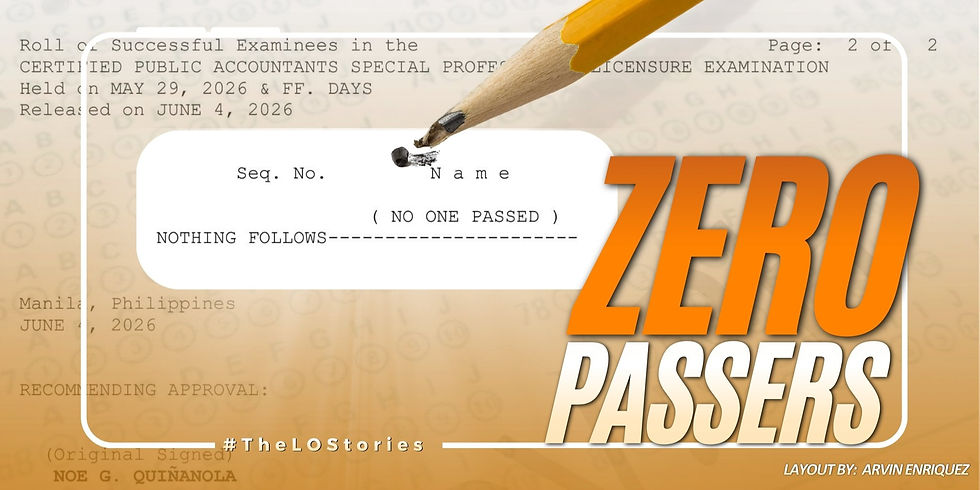
Zero.
The Professional Regulation Commission announced that no examinee passed the May 2026 Certified Public Accountants Special Professional Licensure Examination (SPLE), resulting in a 0 percent passing rate for one of the country’s most demanding professional tests.
While the announcement is brief, its implications extend beyond statistics.
The SPLE is primarily administered for Filipinos working or residing abroad who seek professional licensure without returning to the Philippines to take regular board examinations. Passing the CPA licensure exam is often viewed as a gateway to expanded career opportunities, professional advancement, and greater earning potential.
The absence of passers raises questions about the challenges facing examinees, particularly overseas Filipino professionals balancing work commitments, family responsibilities, and limited access to review resources while preparing for a highly technical examination.
Accountancy has long been regarded as one of the country’s most rigorous professional disciplines. The licensure examination covers financial accounting, auditing, taxation, regulatory frameworks, management advisory services, and business law—subjects requiring both theoretical mastery and practical application.
Historically, CPA board examinations have recorded fluctuating passing rates, reflecting the profession’s stringent standards and the critical role accountants play in ensuring financial integrity and public trust.
Under the Philippine Accountancy Act of 2004, the accountancy profession is recognized as one imbued with public interest, requiring practitioners to demonstrate competence, ethical responsibility, and technical expertise before obtaining a license.
For aspiring CPAs, the results serve as a reminder that professional examinations are not merely academic hurdles but assessments designed to uphold the quality and credibility of the profession.
At the same time, the outcome may prompt discussions among educators, review institutions, and regulatory authorities regarding examination preparedness, support systems for overseas examinees, and the broader factors contributing to performance outcomes.
For the public, the result highlights a less visible reality behind every board examination.
Each examinee represents years of study, personal sacrifice, financial investment, and professional aspiration. A 0 percent passing rate is not simply an absence of names on a list—it is a reflection of challenges encountered by individuals striving to meet the standards of a highly respected profession.
While no one passed the May 2026 SPLE for Certified Public Accountants, the result is unlikely to mark the end of those professional journeys. For many examinees, it becomes another chapter in a process defined not only by competence, but also by resilience.
After all, in professions built on precision and accountability, setbacks are often measured not by failure alone, but by the determination to try again.


Comments